Financial Freedom Roadmap for Beginners
Escaping the 9-5 and Living Life on Your Terms
The dream is universal: waking up without the shrill cry of an alarm clock, knowing that your bills are paid, your future is secure, and your time belongs entirely to you. This isn’t just a fantasy reserved for lottery winners or Silicon Valley tech moguls. It is a measurable, achievable state called Financial Freedom.
Financial freedom isn’t necessarily about having millions of dollars in a vault like Scrooge McDuck. It is the point where your passive income—money earned from investments, businesses, or assets—covers your living expenses. When you reach this tipping point, work becomes an option, not a requirement.
However, the path from “living paycheck to paycheck” to “total independence” is often obscured by complex jargon, predatory schemes, and the noise of consumer culture. This guide is your definitive roadmap. We will strip away the fluff and provide a hard-hitting, step-by-step strategy to take you from financial anxiety to absolute liberty.
Phase 1: The Psychological Shift – Redefining Your Relationship with Money
Before you open a brokerage account or cut up a credit card, you must fix your mindset. Most people fail to achieve financial freedom because they view money as something to be spent rather than something to be deployed.
Stop Being a Consumer, Start Being an Owner
Society conditions us to be consumers. We are taught that success looks like a new BMW, a designer wardrobe, and the latest iPhone. In reality, these are “depreciating assets”—items that lose value the moment you buy them. To achieve freedom, you must transition into an Owner Mindset. Owners buy assets: stocks, real estate, and businesses. They understand that every dollar spent on a “want” is a soldier that could have been sent out to bring back more dollars.
The “Why” Power
Financial freedom requires discipline. There will be times when you want to blow your savings on a vacation or a new gadget. To stay the course, you need a “Why” that is stronger than your “Want.”
- Is it to spend more time with your children?
- Is it to travel the world indefinitely?
- Is it to escape a soul-crushing job?
- Is it to pursue a creative passion without worrying about the rent?
Write your “Why” down. It is the fuel for your journey.
Phase 2: The Financial Audit – Knowing Your Numbers
You cannot navigate to a destination if you don’t know your starting coordinates. Most people have a vague idea of their finances, but vagueness is the enemy of freedom.
Calculate Your Net Worth
Your net worth is a simple snapshot of your financial health. Formula: Total Assets (What you own) – Total Liabilities (What you owe) = Net Worth.
- Assets: Cash, savings, retirement accounts, home equity, investments.
- Liabilities: Credit card debt, student loans, car loans, mortgages.
Don’t be discouraged if your number is negative. This is your “Ground Zero.” Your goal is to see this number increase every single month.
Track Your Cash Flow
For the next 30 days, track every single penny that enters and leaves your life. Use apps like YNAB (You Need A Budget), Empower, or a simple spreadsheet. Categorize your spending into “Needs” (Rent, Food, Utilities) and “Wants” (Netflix, Dining out, Amazon hauls).
Identify the “Leaky Bucket”
Most people have a “leaky bucket” problem. Small, recurring expenses—subscriptions you don’t use, high-interest debt, or “convenience” spending—drain your wealth. Identifying these leaks is the fastest way to give yourself a “raise” without actually earning more money.
Phase 3: The Foundation – Building the Safety Net
You cannot build a skyscraper on a swamp. Before you start investing for the long term, you must protect yourself from the short term.
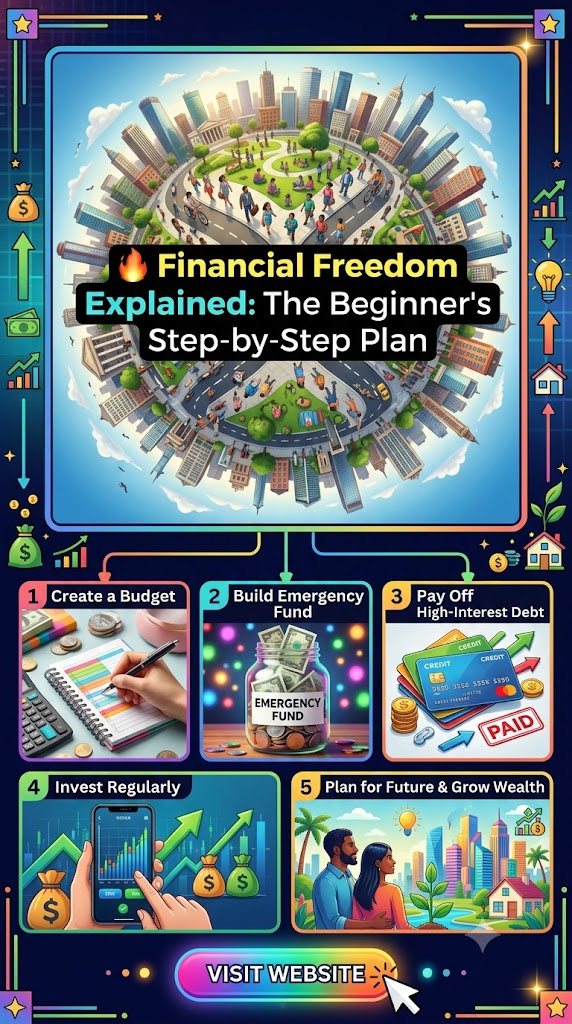
Step 1: The Starter Emergency Fund
Life happens. Tires blow out, water heaters leak, and pets get sick. Without an emergency fund, these events force you back into debt. Aim for a “Starter Fund” of $1,000 to $2,000. This is your “Stability Shield.” Keep this money in a High-Yield Savings Account (HYSA) so it stays liquid but still earns a little interest.
Step 2: Kill the “High-Interest” Monsters
Not all debt is created equal, but high-interest debt (anything over 7-8%) is a financial emergency. Credit card debt is the most common culprit, often carrying 20-30% interest rates.
Use one of two proven methods:
- The Debt Snowball: Pay off the smallest balance first for the psychological win, then move to the next.
- The Debt Avalanche: Pay off the debt with the highest interest rate first to save the most money mathematically.
Pick the one that keeps you motivated. The goal is to eliminate non-mortgage, high-interest debt entirely.
Phase 4: The Defense – Scaling the Safety Net
Once the high-interest debt is gone, it’s time to build your “Full Emergency Fund.” This should cover 3 to 6 months of your essential living expenses.
This fund serves two purposes:
- Survival: If you lose your job, you won’t lose your home.
- Confidence: This is “F-You Money.” It gives you the power to walk away from toxic situations or take calculated risks because you know you are covered.
Phase 5: The Engine – Increasing the Gap
Financial freedom is dictated by “The Gap”—the difference between what you earn and what you spend. To reach your goal faster, you must widen this gap from both sides.
Strategy A: Ruthless Prioritization (Frugality)
Frugality isn’t about being cheap; it’s about being efficient.
- The 48-Hour Rule: Wait 48 hours before any non-essential purchase over $50. Usually, the urge passes.
- House Hacking: If you’re a renter or homeowner, can you get a roommate or rent out a room on Airbnb to cover your housing costs? Housing is usually the biggest expense; solving it accelerates your timeline by years.
Strategy B: Aggressive Income Growth
There is a limit to how much you can cut, but there is no limit to how much you can earn.
- Negotiate Your Salary: If you haven’t asked for a raise in 12 months, you are likely being underpaid. Research market rates and present your value.
- Skill Up-leveling: Spend 5 hours a week learning a high-value skill (coding, digital marketing, sales, AI prompt engineering).
- The Side Hustle: In the digital age, everyone should have a secondary income stream. Whether it’s freelancing on Upwork, starting a YouTube channel, or flipping items on eBay, that extra $500–$1,000 a month should go straight into your investment “Engine.”
Phase 6: The Accelerator – Investing for Passive Income
This is where the magic happens. This is where your money starts making babies, and those babies start making babies. This is Compound Interest.
The Power of Compounding
If you invest $500 a month at a 7% annual return, after 30 years, you will have nearly $600,000. If you wait 10 years to start, you’ll have less than half that. Time is the most powerful variable in the wealth equation.
Where to Put Your Money (The Hierarchy of Investing)
- Employer Match (The 401k/403b): If your employer offers a “match,” this is a 100% return on your money. Never leave this on the table. It is literally free money.
- The Roth IRA: This is a retirement account where you pay taxes now, and your money grows tax-free forever. It is one of the most powerful tools for a beginner.
- Low-Cost Index Funds: Don’t try to “beat the market” by picking individual stocks like Tesla or Apple. Most professionals can’t even do that. Instead, buy the whole market.
- VTSAX (Vanguard Total Stock Market Index Fund) or VTI (ETF version) allows you to own a piece of every public company in the U.S.
- When the economy grows, you grow.
- Real Estate: Once you have a solid foundation in the stock market, real estate offers leverage (using the bank’s money to buy assets) and significant tax advantages.
Phase 7: The “Freedom Number” and the 4% Rule
How do you know when you are actually “Free”? You need to calculate your FIRE Number (Financial Independence, Retire Early).
The 4% Rule
Based on historical market data (the Trinity Study), if you withdraw 4% of your investment portfolio annually, your money is highly likely to last 30 years or more, as the growth usually outpaces the withdrawal.
The Math:
- Calculate your annual expenses (e.g., $40,000/year).
- Multiply that number by 25.
- $40,000 x 25 = $1,000,000.
In this scenario, $1 million is your Freedom Number. Once you hit that, you are mathematically independent. If your expenses are lower, your number is lower. If you “House Hack” or live in a low-cost area, you might only need $600,000.
Phase 8: Avoiding the “Final Boss” – Lifestyle Creep
As you follow this roadmap, your income will likely increase. This is where most people fail. They reach a higher salary and immediately buy a bigger house, a faster car, and more expensive wine. This is Lifestyle Creep.
If your income goes up by $1,000 a month, keep living like you were before and put that $1,000 directly into your investments. This is how you “warp speed” your way to freedom. You don’t have to live like a monk, but you should “live like a student” for as long as possible while your net worth explodes.
Phase 9: Optimization – Tax Efficiency and Automation
Once the engine is running, you need to optimize it for maximum speed.
Automate Everything
Human beings have limited willpower. If you have to manually move money into your savings every month, you will eventually forget or talk yourself out of it.
- Set up an automatic transfer from your paycheck to your 401k.
- Set up an automatic transfer from your bank account to your Roth IRA.
- Set up an automatic transfer to your brokerage account. Make wealth-building the “default” setting of your life.
Tax Optimization
Learn the difference between “Tax-Deferred” (pay taxes later) and “Tax-Exempt” (never pay taxes again). Use Health Savings Accounts (HSAs) if available; they are “Triple Tax Advantaged” and represent the single best investment vehicle in the U.S. tax code.
Phase 10: The Exit Strategy – What Happens at the Finish Line?
Reaching the “Freedom Number” is a strange feeling. For years, you’ve been a “striver.” Now, you are a “keeper.”
The Transition
You don’t have to quit your job the day you hit your number. Many people choose “Coast FIRE”—they stop contributing to their investments and just work enough to cover their daily expenses, letting their existing nest egg grow untouched. Others choose “Barista FIRE”—working a low-stress, part-time job for health insurance and social interaction while their investments do the heavy lifting.
Beyond the Money
The ultimate goal of financial freedom is not to do nothing. It is to do anything.
- What would you do if you weren’t paid to do it?
- What problems do you want to solve in the world?
- How do you want to be remembered?
Financial freedom gives you the rarest commodity on earth: The ability to be the architect of your own time.
Common Pitfalls to Avoid on Your Journey
- The “Get Rich Quick” Trap: Crypto moonshots, meme stocks, and “guaranteed” trading bots are shortcuts to poverty. Stick to the roadmap. Slow and steady wins the race.
- Comparing Your Chapter 1 to Someone Else’s Chapter 20: Social media is a lie. That influencer in the private jet is likely drowning in debt. Focus on your own spreadsheet.
- Ignoring Health: There is no point in being the richest person in the graveyard. Your health is your first wealth. Eat well and exercise so you can actually enjoy your freedom.
- Paralysis by Analysis: Don’t wait until you understand every nuance of the tax code to start. Open an account today. Put in $50. The best time to start was 10 years ago; the second best time is right now.
Summary Checklist for Beginners
- Month 1: Track every expense and calculate your current Net Worth.
- Month 2: Build a $1,000 Starter Emergency Fund.
- Month 3-6: Aggressively pay off all credit cards and high-interest loans.
- Month 6-12: Build a 3-6 month “Full” Emergency Fund.
- Year 1+: Max out employer match, open a Roth IRA, and automate monthly contributions to an S&P 500 Index Fund.
- Ongoing: Increase your income through skills and side hustles while keeping your expenses stable.
Final Thought
Financial freedom is 20% head knowledge and 80% behavior. The math is actually quite simple: spend less than you earn, invest the difference, and wait. The hard part is the “wait” and the discipline to ignore the temptations of a consumer-driven world.
You are now equipped with the roadmap. The path is clear, the steps are laid out, and the destination is life-changing. It’s time to stop dreaming about freedom and start building it. Your future self will thank you for the work you start today.