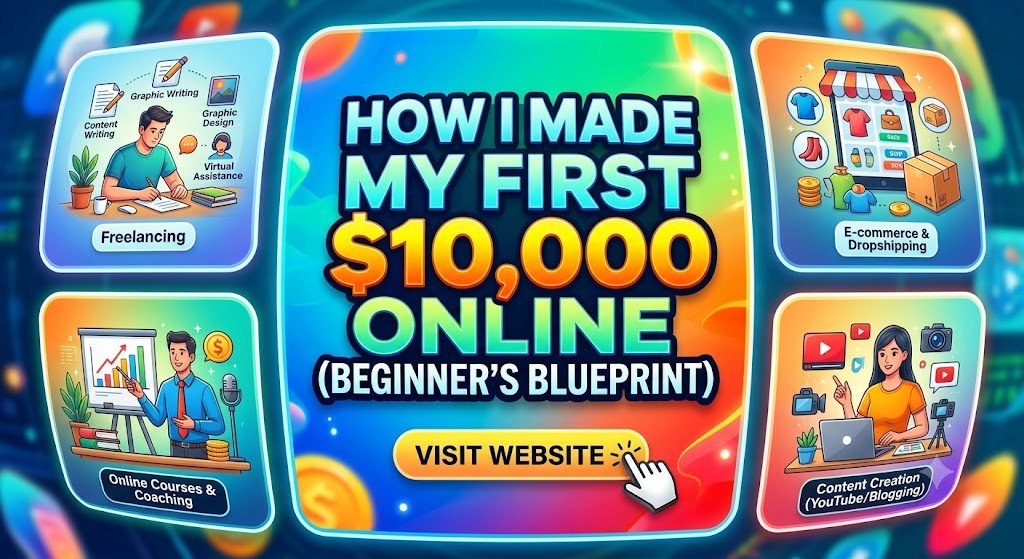
How to Make Your First $10,000 Online: Beginner Roadmap
The $10,000 Blueprint: A No-Nonsense Beginner’s Roadmap to Your First Five-Figure Month Online
The internet has democratized wealth, but it has also democratized noise. Every day, you are bombarded with “get rich quick” schemes, crypto moonshots, and dropshipping gurus promising millions while sipping coconuts on a beach. This is not that kind of guide.
Making your first $10,000 online is a significant milestone. It is the point where your “side hustle” becomes a legitimate business. It is the point where you realize that financial freedom is not a myth, but a mathematical equation. However, the path from $0 to $10,000 is the hardest stretch you will ever face. It requires a shift in identity, a mastery of high-value skills, and an ironclad strategy.
This article is your comprehensive roadmap. We will strip away the fluff and focus on the battle-tested frameworks that actually work in today’s digital economy.
Phase 1: The Psychology of the Five-Figure Goal
Before you pick a business model, you must fix your motherboard. Most beginners fail because they treat online business like a lottery ticket rather than a craft.
The “Value In, Money Out” Principle
Money is simply a representation of value exchanged. To make $10,000, you must provide $10,000 worth of value to the marketplace. This can be done in two ways:
- Mass Value: Providing a small amount of value to thousands of people (e.g., a $10 e-book sold to 1,000 people).
- High-Ticket Value: Providing a massive amount of value to a few people (e.g., a $2,500 service sold to 4 clients).
For a beginner, High-Ticket Value is almost always the faster route to $10,000.
Escaping “Shiny Object Syndrome”
The biggest killer of progress is jumping from one trend to another. One week it’s AI art, the next it’s Amazon FBA. To reach $10,000, you must pick one vehicle and drive it until the odometer hits the goal. Depth beats breadth every single time.
Phase 2: Choosing Your Vehicle (The 3 Proven Models)
There are dozens of ways to make money, but for a beginner seeking their first $10k, these three models offer the lowest barrier to entry and the highest success rate
1. Why $10,000 Is the Perfect First Milestone
Learn why aiming for your first $10,000 online is realistic and how it builds confidence, skills, and long-term income opportunities.
2. Choose One Profitable Online Income Method
Avoid chasing every trend. Focus on one proven path such as freelancing, affiliate marketing, blogging, e-commerce, or content creation.
3. Identify High-Income Skills You Can Learn
Discover beginner-friendly skills like copywriting, graphic design, video editing, coding, SEO, and social media management that businesses pay for.
4. Set Up Your Online Presence
Create a professional profile, portfolio, LinkedIn account, or personal website to build trust and attract potential clients or customers.
5. Find Your First Paying Client or Customer
Learn practical strategies to land your first sale using freelance marketplaces, networking, social media, and referrals.
6. Build Multiple Income Streams
Don’t rely on a single source. Combine freelancing, affiliate marketing, digital products, and passive income to grow faster.
7. Create a Simple Weekly Action Plan
Break your goal into daily and weekly tasks that keep you consistent and moving toward your first $10,000.
8. Reinvest Your Early Earnings Wisely
Use your first profits to improve your tools, marketing, education, or business instead of spending everything immediately.
9. Avoid the Biggest Beginner Mistakes
Learn how to avoid scams, shiny object syndrome, poor time management, and unrealistic expectations that slow progress.
10. Scale From $10,000 to a Full-Time Online Income
Once you reach your first milestone, automate systems, raise your rates, expand your audience, and create recurring revenue for long-term success.
2. The Content-Based Ecosystem (Affiliate & Organic)
This model focuses on building an audience and recommending products.
- The Vehicles: A YouTube channel, a Niche Newsletter (Substack), or a Twitter/X personal brand.
- The Logic: You build trust with an audience and monetize via affiliate links, sponsorships, or your own small digital products.
- The Advantage: Massive scalability and long-term passive income potential.
3. Remote Sales & Appointment Setting
This is the “dark horse” of online income. Many established influencers and companies have products but no one to sell them.
- The Role: You act as the middleman, taking discovery calls or closing deals for a percentage of the sale (commission).
- The Logic: Selling a $5,000 coaching program for a 10% commission means $500 per sale. Twenty sales a month puts you at $10,000.
- The Advantage: You don’t need to create a product or handle customer support.
Phase 3: Skill Acquisition (The Foundation)
You cannot sell “nothing.” You need a skill that solves a “bleeding neck” problem for a business owner. A bleeding neck problem is something that is costing a company money or preventing them from making more.
High-Income Skills to Master in 30 Days:
- Short-Form Video Editing: Every brand now needs TikToks, Reels, and Shorts. If you can make high-retention videos, you are a godsend to creators.
- Direct Response Copywriting: The art of writing words that sell. If you can write an email that generates $5,000 in sales, a business will happily pay you $1,000 to write it.
- Technical SEO & Content Strategy: Helping businesses rank on Google to get “free” traffic.
- AI Operations: Prompt engineering for businesses to automate their workflows.
How to learn: Don’t go back to college. Spend 20 hours on YouTube University, buy one highly-rated course on Udemy or Coursera, and then—most importantly—practice for 50 hours for free to build a portfolio.
Phase 4: The Math of $10,000
Beginners often view $10,000 as a giant, insurmountable wall. In reality, it’s just a series of small bricks. Let’s look at the “Math of 10k”:
- Scenario A (The Freelancer): 4 clients x $2,500/month = $10,000.
- Scenario B (The Consultant): 10 hours of consulting x $1,000/hour = $10,000.
- Scenario C (The Digital Product Creator): 200 sales x $50 product = $10,000.
- Scenario D (The Appointment Setter): 20 closed deals x $500 commission = $10,000.
Notice how Scenario A and D are much more realistic for a beginner than Scenario C. Selling to 200 people requires a massive amount of traffic. Selling to 4 people requires high-quality outreach.
Phase 5: The Outreach Engine (Generating Leads)
You can be the best editor or copywriter in the world, but if nobody knows you exist, you will stay broke. You need an “Outreach Engine.”
The Rule of 100
To get your first few clients, you must commit to the Rule of 100. Every day, perform 100 “outreach actions” for 30 days straight.
- 100 Cold Emails.
- 100 DMs on LinkedIn/Twitter.
- 100 Loom videos sent to potential leads.
The “Value First” Pitch
Stop sending messages that say, “Hi, I’m a freelancer, please hire me.” That goes straight to the trash. Instead, use the Loom Strategy:
- Identify a potential client.
- Find something they are doing wrong (e.g., their YouTube thumbnails are weak or their website copy is boring).
- Record a 2-minute video (using Loom) showing them exactly how to fix it.
- Send it to them for free with no strings attached.
This builds instant authority and reciprocity. Out of 100 Looms, you will likely get 5-10 meetings. Out of those meetings, you will close 1-2 clients.
Phase 6: Content Strategy (The Inbound Magnet)
While you are doing outbound outreach (hunting), you should also be building an inbound magnet (farming). This means creating content that attracts your ideal client to you.
The “Learn-Out-Loud” Framework
You don’t need to be an expert to create content. Simply document your journey:
- “What I learned today about Facebook Ads.”
- “I analyzed 50 high-performing TikToks, here is what they have in common.”
- “The exact workflow I use to edit videos in 2 hours.”
By sharing your process, you demonstrate your competence. Over time, people will start DMing you asking for your services.
Phase 7: Scaling from $1,000 to $10,000
Getting to your first $1,000 is about grit. Getting from $1,000 to $10,000 is about systems.
1. Increase Your Prices
The biggest mistake beginners make is staying cheap. Once you have 3 happy clients, double your prices. “Cheap” clients are usually the most demanding and difficult. “High-ticket” clients understand the value of their time and yours.
2. Productize Your Service
Instead of offering “general marketing,” offer a “30-Day Content Explosion Package.” When you turn your service into a product with a clear name and a clear outcome, it becomes much easier to sell.
3. Eliminate and Delegate
Once you hit $3,000–$5,000 a month, you will hit a time ceiling. You cannot work more hours. At this point, you must:
- Automate: Use tools like Zapier or Calendly to handle admin tasks.
- Delegate: Hire a Virtual Assistant (VA) for $5–$10/hour to handle lead generation or basic editing, freeing you up to focus on high-level sales and strategy.
Phase 8: Avoiding the “Valley of Death”
The “Valley of Death” is the period between Month 2 and Month 6 where the initial excitement has worn off, but the big money hasn’t started rolling in yet. This is where 90% of entrepreneurs quit.
How to survive:
- Ignore the “L” (Losses): You will send emails that get ignored. You will have sales calls where people laugh at your price. This is data, not a defeat.
- Focus on Leading Indicators: Don’t check your bank account every day. Check your “Input Tracker.” Did you send your 100 DMs? Did you post your content? If you win the inputs, the outputs will eventually take care of themselves.
- Environment Design: Join a community of like-minded people. If your friends are all complaining about their 9-to-5s, their energy will pull you down. Find a “Mastermind” or a Discord group of people aiming for the same $10k goal.
Phase 9: The Tools of the Trade
To run a $10k/month business, you need a lean, efficient tech stack. Avoid over-engineering your business.
- Communication: Slack (internal), Zoom/Google Meet (clients).
- Payments: Stripe or PayPal.
- CRM (Lead Tracking): A simple Trello board or Notion database.
- Outreach: Apollo.io (for finding emails) or LinkedIn Sales Navigator.
- Content Creation: Canva (design), CapCut (video), and ChatGPT (brainstorming/outlining).
Keep your overhead low. In the beginning, your goal should be a 90% profit margin.
Phase 10: The “Next Level” Mindset
Once you hit $10,000, your perspective will change. You will realize that $10k isn’t actually that much money—it’s just the beginning. To go from $10k to $100k, you stop being a “freelancer” and start being an “owner.”
The Transition:
- From “I do the work” to “I lead the team.”
- From “I trade time for money” to “I build assets.”
- From “I look for clients” to “I build a brand.”
But don’t worry about $100k yet. Your only job right now is to find one person with a problem and solve it for money. Then find two. Then find four.
Summary: Your 90-Day Action Plan
- Days 1–14: Skill Immersion. Pick one high-value skill (Copy, Video, Ads). Spend 4 hours a day learning and practicing. Build a “mock” portfolio of 3 items.
- Days 15–30: The Foundation. Set up your LinkedIn profile and a simple landing page (or even just a Google Doc portfolio). Define your “Offer” (What do you do, for whom, and what is the result?).
- Days 31–60: The Outreach Blitz. Execute the Rule of 100. Send Looms, DMs, and Emails. Your goal is to get 10 sales calls. Aim for your first “Beta” client at a lower price point to get a testimonial.
- Days 61–90: Optimization. Use your testimonial to sign two full-priced clients. Refine your delivery process so it takes you less time. Start posting content to attract inbound leads.
The $10,000 month is not a result of luck. It is a result of a specific set of actions repeated until the math works out.
Stop scrolling. Stop “researching.” Pick your skill, start your outreach, and don’t stop until the notification on your phone says you’ve hit the five-figure mark. The internet is waiting to pay you—go and claim it.