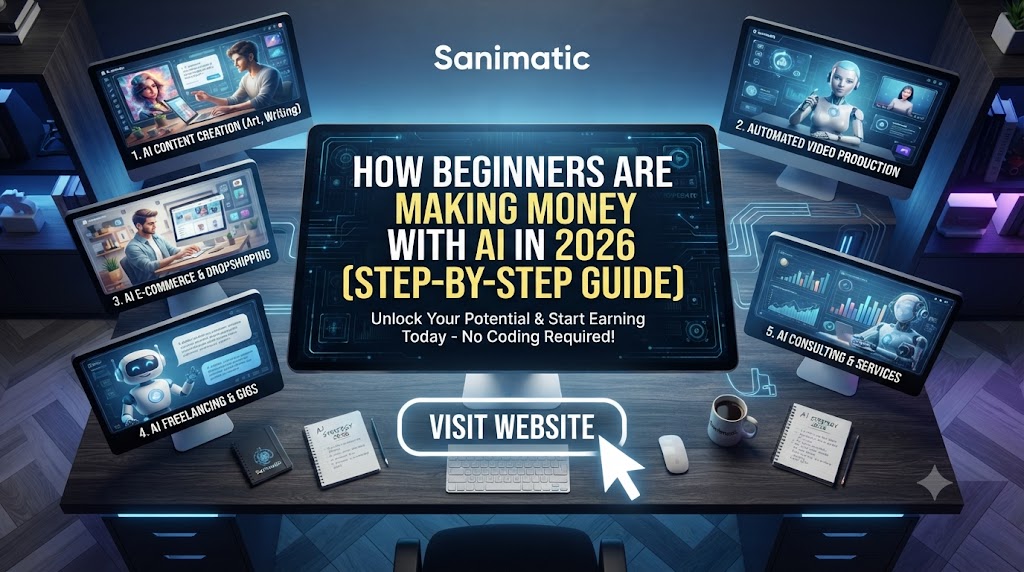
How Beginners Are Making Money With AI
The AI Gold Rush: A Comprehensive Guide on How Beginners Are Making Money With AI
The landscape of wealth creation has shifted. For decades, the barrier to entry for high-income skills—like coding, professional graphic design, or complex data analysis—required years of study and significant financial investment. Today, that barrier has been pulverized by Artificial Intelligence.
We are currently living through the “Great Democratization of Skill.” AI is not just a tool for tech giants; it is a leverage point for the average person. Whether you are a student, a stay-at-home parent, or someone looking to escape the 9-to-5 grind, the opportunities to monetize AI are vast, varied, and, most importantly, accessible.
This guide explores the exact frameworks, tools, and strategies beginners are using right now to turn AI into a consistent revenue stream.
1. AI-Powered Freelance Writing and Content Strategy
Writing is perhaps the most immediate way to monetize AI. While some feared AI would “kill” the writing profession, it has actually empowered “AI-Augmented Writers” to produce 10x the volume at 2x the quality.
The Shift from Writer to Editor
Beginners are no longer staring at a blank page. They are using tools like ChatGPT (GPT-4), Claude 3.5 Sonnet, and Jasper to generate first drafts, outlines, and research summaries. The money is in the “Human-in-the-Loop” model—taking AI output and refining it with personal anecdotes, fact-checking, and a unique brand voice.
High-Demand Services:
- SEO Blogging: Using AI to identify keywords (via Ahrefs or SEMRush) and then generating long-form content that ranks on Google.
- Email Marketing: Crafting high-converting sales sequences for e-commerce brands.
- Technical Documentation: Using AI to explain complex software features to laypeople.
- LinkedIn Ghostwriting: Executives are desperate for “thought leadership.” Beginners use AI to transform an executive’s rough ideas into polished daily posts.
How to Scale:
Don’t charge by the hour; charge by the project. Since AI allows you to finish a 2,000-word article in 45 minutes instead of 5 hours, your effective hourly rate skyrockets.
2. The Rise of Faceless YouTube Channels
Video content is the king of social media, but many people are too shy to be on camera. AI has solved this problem entirely. Beginners are creating “Faceless Channels” that generate thousands of dollars in ad revenue and sponsorships without ever showing their faces.
The Workflow:
- Niche Selection: AI (like Perplexity) helps identify trending topics with low competition.
- Scripting: ChatGPT or Claude writes a 10-minute engaging script.
- Voiceover: ElevenLabs provides ultra-realistic, human-like AI voices that are indistinguishable from real narrators.
- Visuals: Tools like InVideo AI, Pictory, or Canva automatically find stock footage that matches the script.
- Editing: CapCut’s AI features handle the subtitling and transitions.
The Profit Model:
A faceless channel focused on “Daily Stoicism” or “Financial Literacy” can be managed in a few hours a week. Once the channel hits the monetization threshold, it becomes a source of passive income.
3. Generative Art and Visual Content Services
Before 2022, if you wanted a custom logo or a unique illustration, you had to hire a professional artist. Now, with Midjourney, DALL-E 3, and Leonardo.ai, beginners are producing professional-grade visuals in seconds.
Profitable Niches for AI Art:
- Logo Design for Small Businesses: Local businesses often can’t afford $1,000 for a branding package. Beginners offer “AI-Powered Branding” for $150, delivering 10 options in an hour.
- Stock Photography: Platforms like Adobe Stock allow AI-generated images (under specific guidelines). Beginners upload thousands of high-quality, niche images (e.g., “Cyberpunk corporate office” or “Hyper-realistic vegan meal”) and earn royalties.
- Book Cover Design: Self-published authors on Amazon KDP need eye-catching covers. AI can generate stunning fantasy or sci-fi art that fits the genre perfectly.
- Social Media Assets: Creating unique Instagram carousels or Pinterest pins for brands.
4. Prompt Engineering as a Service
The most valuable skill in the AI era is knowing how to talk to the machine. This is called “Prompt Engineering.” While it sounds technical, it is actually about linguistics and logic.
Selling Prompts:
Platforms like PromptBase allow users to sell the exact strings of text used to generate specific results. If you figure out the perfect prompt to create “Photorealistic Architectural Renders” or “High-Converting Facebook Ad Copy,” you can sell that prompt for $2–$10. It’s a “build once, sell forever” model.
Prompt Consulting:
Small business owners know they should use AI, but they are overwhelmed. Beginners are stepping in as “AI Implementation Consultants.” They set up custom GPTs for a local real estate agency or a law firm, teaching them how to automate their repetitive tasks.
5. AI-Enhanced E-Commerce and Print-on-Demand (POD)
Print-on-Demand is a classic side hustle where you sell designs on T-shirts, mugs, and posters without holding inventory. AI has eliminated the “I’m not an artist” excuse.
The Strategy:
- Trend Spotting: Use AI to analyze what’s trending on Etsy or Amazon.
- Design Generation: Use Midjourney to create unique, high-resolution art (e.g., “Aesthetic vintage botanical illustrations”).
- Upscaling: Use tools like Gigapixel AI to make the image large enough for high-quality printing.
- Automation: Use Printful or Printify to link your designs to an Etsy shop. When someone buys, the item is printed and shipped automatically.
Beginners are finding success by focusing on “Micro-Niches”—extremely specific hobbies like “Left-handed fly fishing enthusiasts” or “Cybersecurity experts who love cats.”
6. Developing Micro-SaaS and “Wrapper” Apps
You no longer need a Computer Science degree to build software. AI coding assistants like GitHub Copilot, Cursor, and Replit Agent allow beginners to build “Micro-SaaS” (Software as a Service) applications.
What is a “Wrapper”?
A wrapper is a simple application that uses a large AI model (like OpenAI’s GPT-4) but provides a specific, user-friendly interface for a particular task.
Examples:
- An AI tool specifically for writing real estate listings.
- A Chrome extension that summarizes legal contracts into “plain English.”
- A recipe generator that suggests meals based on a photo of your fridge.
By using “No-Code” tools like Bubble or Softr in conjunction with AI, beginners are launching functional apps in days rather than months.
7. AI Chatbot Agencies for Local Businesses
Every local business—from dentists to plumbers—struggles with lead capture. Their websites are often static, and they lose customers because they don’t answer the phone or reply to emails fast enough.
The Opportunity:
Beginners are using platforms like Botpress, Stack AI, or Chatbase to build custom AI chatbots for these businesses. These bots can:
- Answer 24/7 customer FAQs.
- Book appointments directly into a calendar.
- Qualify leads before passing them to a human.
The Income: You can charge a $500–$2,000 setup fee and a $100/month maintenance fee. Scaling to just 10 local clients creates a significant monthly recurring revenue (MRR).
8. Digital Product Creation: E-Books and Courses
The “Knowledge Economy” is booming. AI makes it possible to package information into sellable products at lightning speed.
E-Books:
Beginners are using AI to outline, draft, and format niche non-fiction e-books. The key isn’t to let the AI write the whole thing, but to use it as a researcher and structural editor. These books are then sold on Amazon KDP or Gumroad.
Online Courses:
Tools like Coursebox use AI to generate an entire course curriculum, quizzes, and even video scripts from a single prompt. If you have expertise in a specific area (e.g., “How to grow organic tomatoes”), AI can help you turn that knowledge into a professional digital course in a weekend.
9. Data Labeling and AI Training
For those who want a more “low-stakes” entry into the AI world, AI companies actually need humans to “train” their models. This involves correcting AI mistakes, labeling images, or ranking different AI responses.
Where to find work:
Platforms like DataAnnotation.tech, Remotasks, and Outlier.ai pay individuals to interact with AI. While this isn’t “entrepreneurship” in the traditional sense, it’s a reliable way for beginners to earn $20–$40 per hour working from home while learning how AI models think.
10. Social Media Management and Growth Hacking
Managing social media is time-consuming. AI turns a 40-hour workweek into a 5-hour one.
Modern SMM Services:
- Content Repurposing: Taking one long YouTube video and using AI (like Munch or OpusClip) to turn it into 10 viral TikToks and Reels.
- Caption Generation: Using AI to write high-engagement captions and hashtags.
- Community Management: Using AI to filter and draft responses to comments and DMs.
Beginners are signing 3–5 clients at $1,000/month each, using AI to handle the heavy lifting of content creation and scheduling.
The “Secret Sauce” for Success with AI
While the tools are powerful, most beginners fail because they treat AI like a “magic button.” To actually make money, you must follow these three principles:
A. Focus on the “Last Mile”
The AI gets you 80% of the way there. The final 20%—the fact-checking, the emotional resonance, the formatting, and the branding—is where the value lies. That 20% is what clients pay for.
B. Solve a Specific Pain Point
Don’t just sell “AI services.” Sell a solution.
- Don’t say: “I will write AI blogs for you.”
- Do say: “I will help your plumbing business rank on the first page of Google so you get more calls.”
C. Stack Your Tools
The real money is made when you combine AI tools.
- Example: Use Perplexity for research + Claude for writing + Midjourney for visuals + Canva for layout = A high-ticket PDF guide you can sell.
Common Pitfalls to Avoid
- Copyright Issues: Always check the terms of service of the AI tool you are using. Generally, most paid tiers (like Midjourney or ChatGPT Plus) grant you commercial rights, but the legal landscape is still evolving.
- AI Hallucinations: AI can and will lie confidently. Never deliver a product (especially technical or medical content) without thorough fact-checking.
- Low-Quality Spam: The market is being flooded with “lazy” AI content. To stand out, your work must be indistinguishable from high-quality human work.
How to Get Started Today (Step-by-Step)
If you are overwhelmed, follow this simple path to your first $1,000 with AI:
- Pick ONE Niche: Choose something you are interested in (e.g., Real Estate, Fitness, Pet Care).
- Master ONE Tool: Spend 10 hours becoming an expert in Midjourney or ChatGPT.
- Create a Portfolio: Spend a weekend creating 5 high-quality examples of your work (e.g., 5 AI-written blog posts or 5 AI-designed logos).
- Outreach: Go to platforms like Upwork, Fiverr, or even LinkedIn. Offer your services at a discount to your first 3 clients to get testimonials.
- Iterate and Scale: Once you have a proven workflow, increase your prices and start exploring automation.
The Bottom Line
AI is not going to replace humans, but humans using AI will replace humans who don’t. The barrier to entry has never been lower, and the potential for profit has never been higher. The question isn’t whether you can make money with AI—it’s which of these paths you will choose to master first.
The “AI Gold Rush” is in its early stages. There is still time to stake your claim, but the best time to start was yesterday. The second best time is right now.