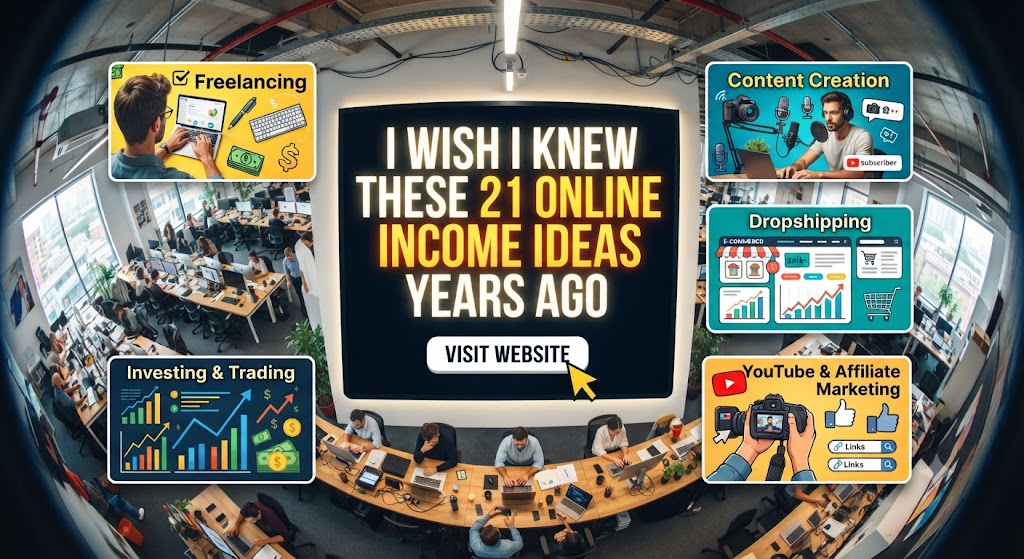
I Wish I Knew These Online Income Ideas Sooner
I Wish I Knew These Online Income Ideas Sooner: The Ultimate Blueprint to Financial Freedom
If I could go back in time and hand my younger self a manual for the digital age, it wouldn’t be a list of stocks. It would be these income streams. These aren’t just “side hustles”; they are scalable, repeatable, and high-leverage business models that have the power to replace a full-time salary and then some.
In this comprehensive guide, we will break down the exact online income ideas I wish I had started sooner, ranging from high-ticket skill-based services to passive digital assets.
1. The High-Ticket Skill Revolution: Ghostwriting and Copywriting
Most people think writing is a low-paying hobby. They think of starving novelists or $5-per-article freelancers on content mills. This is a massive mistake. The highest-paid people on the internet aren’t “writers”; they are Ghostwriters and Copywriters.
Ghostwriting for Executives and Influencers
There is a massive demand for high-level thought leadership on platforms like LinkedIn and X (formerly Twitter). Busy CEOs, founders, and venture capitalists want to build their personal brands but don’t have the time to write three tweets and one long-form post every day.
- Why it works: You are selling time and status.
- The Income Potential: Professional ghostwriters can easily charge $2,000 to $5,000 per month per client. With five clients, you are at a six-figure income.
- How to start: Find an executive whose LinkedIn profile is “dead” or inconsistent. Write three sample posts in their voice and send them a DM. Offer a one-week trial. Once they see the engagement, they won’t want to let you go.
Direct-Response Copywriting
Copywriting is the art of “salesmanship in print.” It is writing that convinces a reader to take a specific action—buy a product, sign up for a newsletter, or click a button.
- The Leverage: Unlike a standard blog post, good copy has a direct Return on Investment (ROI). If you write an email sequence that generates $50,000 in sales for a client, charging $5,000 for that work is a bargain for them.
- Pro Tip: Master the “AIDA” formula (Attention, Interest, Desire, Action).
2. The Rise of the “Faceless” YouTube Channel
For years, people stayed off YouTube because they didn’t want to be on camera. They were shy, or they didn’t have a professional studio setup. Then came the era of Faceless Channels (also known as Cash Cow Channels).
Automation and Curation
A faceless channel relies on stock footage, screen recordings, animations, and voiceovers to tell a story or share information. Think of channels like MagnatesMedia or Daily Stoic.
- The Strategy: Pick a high-CPM (Cost Per Mille) niche. Finance, technology, and luxury lifestyles pay much higher ad rates than comedy or gaming.
- The AI Edge: Today, tools like ElevenLabs (for hyper-realistic AI voices) and Midjourney (for custom visuals) have slashed the cost of production by 90%.
- The Income Stream: Beyond YouTube AdSense, these channels are perfect for affiliate marketing and sponsorships.
3. Selling “Digital Real Estate”: The Notion Template Economy
If I had known that people would pay $50 for a well-organized digital planner, I would have started this years ago. Notion has evolved from a simple note-taking app into a full-blown operating system for businesses and individuals.
Productizing Your Organization
People are overwhelmed by the complexity of life. They want a “system” they can just plug into.
- What to Create: Budget trackers, workout logs, content calendars, or second-brain systems for students.
- The Sales Engine: You can list your templates on marketplaces like Gumroad or Etsy.
- The Scalability: You build the template once. You can sell it 10,000 times with zero additional cost. This is the definition of “passive income.”
4. Short-Form Video Editing (The Modern Gold Mine)
We are currently in the middle of a “Short-Form Gold Rush.” TikTok, Instagram Reels, and YouTube Shorts have fundamentally changed how content is consumed. Every brand and creator is now desperate for high-energy, well-edited vertical video.
The Skill of the Hour
If you can take a 60-minute podcast and chop it into 10 viral clips with Alex Hormozi-style captions, you have a license to print money.
- The Pitch: Don’t ask for a job. Take a creator’s existing long-form video, edit one “fire” 60-second clip, and send it to them.
- Pricing: Editors are currently charging $50 to $150 per clip. A creator who needs 30 clips a month is worth $3,000/month to you.
- Tools to Master: CapCut (Desktop), Adobe Premiere Pro, and Submagic.
5. Paid Newsletters: Building a Media Empire on Substack
The era of the “algorithmic slave” is ending. Creators are tired of being at the mercy of Instagram or Facebook’s changing algorithms. This is why Paid Newsletters have exploded.
The Substack Model
Substack allows you to write content and charge a monthly subscription fee (usually $5-$10) for premium access.
- The Math of Freedom:
- 1,000 subscribers at $7/month = $7,000/month.
- Subtract Substack’s 10% fee, and you are still netting over $6,000/month for writing about a topic you love once or twice a week.
- The Secret: You don’t need to be a world-class journalist. You just need to provide specific value—market analysis, curated industry news, or deep-dives into a niche hobby.
6. Digital Product Ecosystems (Beyond the Course)
Everyone talks about selling “online courses,” but the market has shifted. People are tired of 20-hour courses that they never finish. They want results.
Micro-Products and Workshops
Instead of a $997 course, sell a $47 “Implementation Toolkit.”
- Low Friction: It is much easier to convince a stranger to spend $47 than $1,000.
- The Ladder: Once they buy your small product and see that you are the real deal, they are ten times more likely to buy your high-end coaching or consulting later.
- Examples: A set of 50 Canva templates for realtors; a 1-hour recorded workshop on how to set up an LLC; a PDF guide on “The 10 Best Prompts for AI Image Generation.”
7. The “Middleman” Strategy: Drop-Servicing
You’ve heard of Dropshipping (selling physical products you don’t stock). Drop-servicing is the same concept, but for digital services. It is significantly more profitable because there are no shipping costs or physical returns.
How it Works
- You find a high-demand service (e.g., SEO auditing or Logo Design).
- You build a professional agency website and market that service for $500.
- When a client buys, you hire a vetted freelancer on a platform like Upwork or Fiverr to do the work for $200.
- You manage the project and pocket the $300 difference.
- Why I wish I knew this sooner: It allows you to scale a business without being the one “doing the work.” You become a manager and a marketer rather than a technician.
8. Affiliate Marketing 2.0: The “Bridge Page” Strategy
The old way of affiliate marketing was spamming links on Pinterest and hoping for a click. It’s dead. The new way is building a Value Bridge.
High-Ticket Affiliate Marketing
Instead of selling $20 books for a $1 commission, focus on SaaS (Software as a Service) or high-ticket coaching programs.
- The Recurring Revenue: If you refer someone to a software like ClickFunnels or ConvertKit, you get a commission every single month they stay a subscriber.
- The Bridge: Create a free guide or a YouTube tutorial showing how to solve a problem using that specific tool. Put your link in the description. You are helping people first, which builds the trust necessary for them to use your link.
9. User Testing and Digital Quality Assurance
While not as scalable as a business, User Testing is the fastest way to make “active” money with zero skills.
Getting Paid for Your Opinion
Companies like Google, Airbnb, and Amazon need to know if their websites are intuitive. They will pay you to browse their site and speak your thoughts out loud into a microphone.
- Platforms: UserTesting, TryMyUI, and Userlytics.
- The Pay: Typically $10 for a 20-minute test. If you qualify for “Live Conversations,” you can earn $60 to $120 per hour.
- The Catch: You won’t get 40 hours of work a week. This is perfect “gap filler” money.
10. AI Prompt Engineering and Consulting
AI is the biggest technological shift since the internet itself. Most businesses know they should use AI, but they have no idea how.
Selling Efficiency
If you can learn how to use ChatGPT, Midjourney, or Claude to automate a business’s customer service or content creation, you are an invaluable asset.
- Prompt Bundles: Sell specialized prompt libraries for specific industries (e.g., “The Ultimate Prompt Pack for E-commerce Marketing”).
- AI Integration: Consult for small businesses to show them how to use AI to save 10 hours of work a week. You can charge thousands for this “efficiency transformation.”
The Core Philosophy: Why Most People Fail
I spent years looking for the “perfect” idea. I wish I knew sooner that the idea matters less than the system. Most people fail at online income because of three reasons:
- The Shiny Object Syndrome: They start a YouTube channel, get bored after three videos, and then try dropshipping. Success in the digital economy requires at least 6 months of “unrewarded” effort.
- Focusing on Low-Value Tasks: Spending weeks on a logo instead of talking to potential customers.
- Ignoring the “Value Exchange”: Money is just a reflection of value provided. If you want more money, you must find a way to provide more value to more people.
How to Pick Your Idea
- Do you have more time than money? Start with Ghostwriting or Short-form Video Editing. These require $0 to start and pay high hourly rates.
- Do you have a specific expertise? Start a Substack or create a Notion template.
- Do you want to remain anonymous? Start a Faceless YouTube channel or a Drop-servicing agency.
The Road to $10,000 per Month: A Realistic Timeline
If you are starting from zero today, here is what a realistic path looks like:
- Month 1-2: The Learning Phase. Pick one skill (e.g., Copywriting). Consume every free resource on YouTube. Practice for 2 hours every day. Do work for free to build a portfolio.
- Month 3-4: The Outreach Phase. Start pitching. Send 10-20 DMs or emails a day. Secure your first 2-3 clients at a lower rate. Aim for $2,000/month.
- Month 5-8: The Scaling Phase. Raise your prices. Replace your low-paying clients with high-paying ones. Start building an “asset” (a newsletter or a digital product) on the side using the income from your service business.
- Month 12+: The Freedom Phase. Your side assets start generating passive income. You can now choose to stop the service work or hire someone to do it for you.
Final Thoughts: The Cost of Inaction
The internet is currently the greatest wealth-redistribution tool in human history. The barriers to entry have been demolished. You don’t need a degree, a boss’s permission, or a massive bank account to start.
I wish I knew these ideas sooner, but the second-best time to start is today. Every day you wait is a day of compound interest you are losing. Pick one idea from this list—just one—and commit to it for the next 90 days. Your future self will look back on today as the moment everything changed.
The digital economy is waiting. Are you going to be a consumer, or are you going to be a creator?